
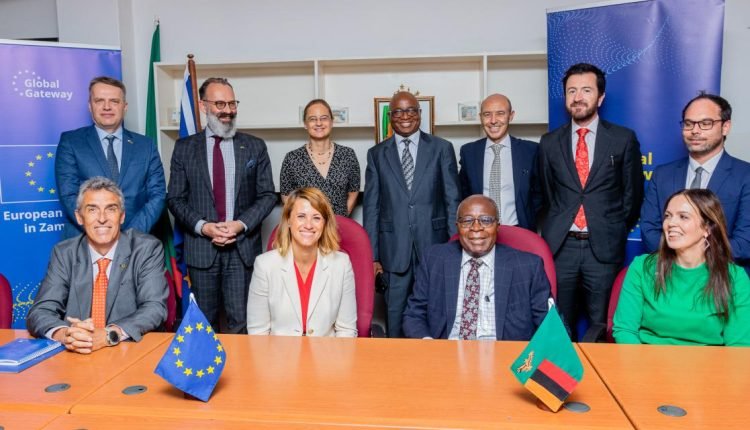
The Government, working in partnership with the European Union (EU) and the International Labour Organisation (ILO), has launched the Labour Market Information System alongside the Mining Sector Skills Body in a move aimed at strengthening skills development and better matching workforce training to industry requirements.
The initiative was unveiled through a collaborative effort involving the Ministry of Labour and Social Security, the Ministry of Mines and Minerals Development, and the Ministry of Science and Technology.
Speaking in a speech delivered on her behalf by Director of Planning and Research Paul Mumba, Labour and Social Security Minister Brenda Tambatamba said the joint launch represents a significant milestone in preparing Zambia’s workforce for the evolving needs of the mining sector, which remains a cornerstone of the national economy.
She noted that rapid changes in market conditions and the increasingly dynamic nature of the extractive industry demand sustained investment in human capital to close existing skills gaps and improve productivity.
Tambatamba explained that the Labour Market Information System will serve as a critical tool for providing timely and reliable labour data, enabling Government to formulate evidence-based policies and respond more effectively to challenges within the labour market.
EU Ambassador to Zambia Karolina Stasiak reiterated the European Union’s continued support for Zambia’s skills development agenda, with particular emphasis on strategic sectors such as mining.
She announced that the EU will roll out a €10 million skills programme starting in 2026, targeting the training and formalisation of artisanal and small-scale miners as part of efforts to promote inclusive growth and sustainable mining practices.
The new platforms are expected to enhance coordination between Government, industry and training institutions, ensuring that skills development initiatives are closely aligned with Zambia’s economic and industrial priorities.